
Logic and Order

Among the impressive skills observed in experienced architects, the strategic use of logic and order in project delivery stands out. Swiftly determining the optimal sequence and arrangement of elements is a hallmark of their proficiency. While many individuals tend to overthink, I recall a specific architect who could, in real-time, generate resolutions rapidly by applying these principles. Reflecting on honing this skill, I remembered LSAT logic games from my consideration of law school many years ago. Upon revisiting them, I recognized that this architect’s efficiency stemmed from a rapid grasp of principles demonstrated in these games.

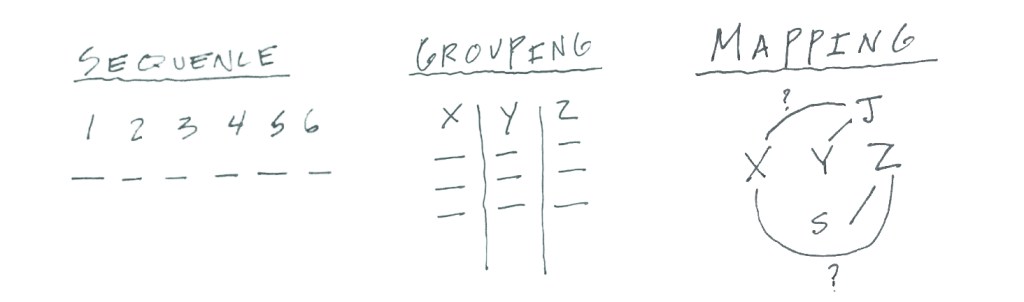
The three primary game types—sequencing (task order or project phasing), grouping/matching (multiple projects or relevant players), and mapping (programming diagrams or space connections)—serve as foundational concepts.In the actual LSAT Logic Games section, you’ll receive a set of rules and variables to use in completing the diagrams provided. The examples given here are only the most basic, and the complexity can increase significantly. For instance, you may encounter a hybrid grouping/sequencing game, such as a real-world scenario where a team must finish their work before another team can begin their respective task.
Light and Shadow

I worked with an experienced architect who possessed an exceptional talent. He could intricately draw shadows on a 2D building projection. Visualizing the shadow cast by a light pole at a 45-degree angle is one thing, but this was far and beyond that capability. This individual could foresee how light would interact with vegetation at unique angles and predict the shadows under arched openings cast by other complex objects. This ability to visualize light and shadow with such precision provided a profound understanding of depth, often requiring physical or digital models for most of us to study. Undoubtedly, some people possess a stronger visual memory than others, but like any skill – I think this one can be improved upon. 

How to work on this skill in under 5 minutes/day: Take pictures or sketch light casting on complex objects or projecting shadows at unfamiliar angles. Diagram the light source or at least try to remember it. You could do 5 of these scenarios/day. In one year that’s 1825 scenarios. You should start seeing patterns. 

Thinking about what makes a great Architect

Lately, I’ve been thinking about what distinguishes a great architect. People often mention qualities like effective communication, keen attention to detail, intuitive design sense, and spatial awareness. While these traits are valuable, they can be somewhat vague. I think architects are too vague too often. I like specific.

So I took a mental inventory of all the seasoned architects and professors with 25 years + experience that I have worked with and came up with three skills they had that knocked my socks off. No one I knew demonstrated all three of these abilities at an exceptionally high level, possibly due to the left brain/right brain dynamic. 
Hint: They all have to do with the concept of Directionality.